AINULINDALË
The Music of the Ainur
There was Eru, the One, who in Arda is called Ilúvatar; and he made first the Ainur, the Holy Ones, that were the offspring of his thought, and they were with him before aught else was made. And he spoke to them, propounding to them themes of music; and they sang before him, and he was glad. But for a long while they sang only each alone, or but few together, while the rest hearkened; for each comprehended only that part of me mind of Ilúvatar from which he came, and in the understanding of their brethren they grew but slowly. Yet ever as they listened they came to deeper understanding, and increased in unison and harmony.
And it came to pass that Ilúvatar called together all the Ainur and declared to them a mighty theme, unfolding to them things greater and more wonderful than he had yet revealed; and the glory of its beginning and the splendour of its end amazed the Ainur, so that they bowed before Ilúvatar and were silent.
Then Ilúvatar said to them: 'Of the theme that I have declared to you, I will now that ye make in harmony together a Great Music. And since I have kindled you with the Flame Imperishable, ye shall show forth your powers in adorning this theme, each with his own thoughts and devices, if he will. But I win sit and hearken, and be glad that through you great beauty has been wakened into song.'
Then the voices of the Ainur, like unto harps and lutes, and pipes and trumpets, and viols and organs, and like unto countless choirs singing with words, began to fashion the theme of Ilúvatar to a great music; and a sound arose of endless interchanging melodies woven in harmony that passed beyond hearing into the depths and into the heights, and the places of the dwelling of Ilúvatar were filled to overflowing, and the music and the echo of the music went out into the Void, and it was not void. Never since have the Ainur made any music like to this music, though it has been said that a greater still shall be made before Ilúvatar by the choirs of the Ainur and the Children of Ilúvatar after the end of days. Then the themes of Ilúvatar shall be played aright, and take Being in the moment of their utterance, for all shall then understand fully his intent in their part, and each shall know the comprehension of each, and Ilúvatar shall give to their thoughts the secret fire, being well pleased.
But now Ilúvatar sat and hearkened, and for a great while it seemed good to him, for in the music there were no flaws. But as the theme progressed, it came into the heart of Melkor to interweave matters of his own imagining that were not in accord with the theme of Ilúvatar, for he sought therein to increase the power and glory of the part assigned to himself. To Melkor among the Ainur had been given the greatest gifts of power and knowledge, and he had a share in all the gifts of his brethren. He had gone often alone into the void places seeking the Imperishable Flame; for desire grew hot within him to bring into Being things of his own, and it seemed to him that Ilúvatar took no thought for the Void, and he was impatient of its emptiness. Yet he found not the Fire, for it is with Ilúvatar. But being alone he had begun to conceive thoughts of his own unlike those of his brethren.
Some of these thoughts he now wove into his music, and straightway discord arose about him, and many that sang nigh him grew despondent, and their thought was disturbed and their music faltered; but some began to attune their music to his rather than to the thought which they had at first. Then the discord of Melkor spread ever wider, and the melodies which had been heard before foundered in a sea of turbulent sound. But Ilúvatar sat and hearkened until it seemed that about his throne there was a raging storm, as of dark waters that made war one upon another in an endless wrath that would not be assuaged.
Then Ilúvatar arose, and the Ainur perceived that he smiled; and he lifted up his left hand, and a new theme began amid the storm, like and yet unlike to the former theme, and it gathered power and had new beauty. But the discord of Melkor rose in uproar and contended with it, and again there was a war of sound more violent than before, until many of the Ainur were dismayed and sang no longer, and Melkor had the mastery. Then again Ilúvatar arose, and the Ainur perceived that his countenance was stern; and he lifted up his right hand, and behold! a third theme grew amid the confusion, and it was unlike the others. For it seemed at first soft and sweet, a mere rippling of gentle sounds in delicate melodies; but it could not be quenched, and it took to itself power and profundity. And it seemed at last that there were two musics progressing at one time before the seat of Ilúvatar, and they were utterly at variance. The one was deep and wide and beautiful, but slow and blended with an immeasurable sorrow, from which its beauty chiefly came. The other had now achieved a unity of its own; but it was loud, and vain, and endlessly repeated; and it had little harmony, but rather a clamorous unison as of many trumpets braying upon a few notes. And it essayed to drown the other music by the violence of its voice, but it seemed that its most triumphant notes were taken by the other and woven into its own solemn pattern.
In the midst of this strife, whereat the halls of Ilúvatar shook and a tremor ran out into the silences yet unmoved, Ilúvatar arose a third time, and his face was terrible to behold. Then he raised up both his hands, and in one chord, deeper than the Abyss, higher than the Firmament, piercing as the light of the eye of Ilúvatar, the Music ceased.
Then Ilúvatar spoke, and he said: 'Mighty are the Ainur, and mightiest among them is Melkor; but that he may know, and all the Ainur, that I am Ilúvatar, those things that ye have sung, I will show them forth, that ye may see what ye have done. And thou, Melkor, shalt see that no theme may be played that hath not its uttermost source in me, nor can any alter the music in my despite. For he that attempteth this shall prove but mine instrument in the devising of things more wonderful, which he himself hath not imagined.'
Then the Ainur were afraid, and they did not yet comprehend the words that were said to them; and Melkor was filled with shame, of which came secret anger. But Ilúvatar arose in splendour, and he went forth from the fair regions that he had made for the Ainur; and the Ainur followed him.
But when they were come into the Void, Ilúvatar said to them: 'Behold your Music!'
[...]
VALAQUENTA
Account of the Valar and Maiar
[...]
Of the Enemies
Last of all is set the name of Melkor, He who arises in Might. But that name he has forfeited; and the Noldor, who among the Elves suffered most from his malice, will not utter it, and they name him Morgoth, the Dark Enemy of the World. Great might was given to him by Ilúvatar, and he was coeval with Manwë. In the powers and knowledge of all the other Valar he had part, but he turned them to evil purposes, and squandered his strength in violence and tyranny. For he coveted Arda and all that was in it, desiring the kingship of Manwë and dominion over the realms of his peers.
From splendour he fell through arrogance to contempt for all things save himself, a spirit wasteful and pitiless. Understanding he turned to subtlety in perverting to his own will all that he would use, until he became a liar without shame. He began with the desire of Light, but when he could not possess it for himself alone, he descended through fire and wrath into a great burning, down into Darkness. And darkness he used most in his evil works upon Arda, and filled it with fear for all living things.
Yet so great was the power of his uprising that in ages forgotten he contended with Manwë and all the Valar, and through long years in Arda held dominion over most of the lands of the Earth. But he was not alone. For of the Maiar many were drawn to his splendour in the days of his greatness, and remained in that allegiance down into his darkness; and others he corrupted afterwards to his service with lies and treacherous gifts. Dreadful among these spirits were the Valaraukar, the scourges of fire that in Middle-earth were called the Balrogs, demons of terror.
Among those of his servants that have names the greatest was that spirit whom the Eldar called Sauron, or Gorthaur the Cruel. In his beginning he was of the Maiar of Aulë, and he remained mighty in the lore of that people. In all the deeds of Melkor the Morgoth upon Arda, in his vast works and in the deceits of his cunning, Sauron had a part, and was only less evil than his master in that for long he served another and not himself. But in after years he rose like a shadow of Morgoth and a ghost of his malice, and walked behind him on the same ruinous path down into the Void.
QUENTA SILMARILLION
The History of the Silmarils
Chapter 1
Of the Beginning of Days
It is told among the wise that the First War began before Arda was full-shaped, and ere yet there was any thing that grew or walked upon earth; and for long Melkor had the upper hand. But in the midst of the war a spirit of great strength and hardihood came to the aid of the Valar, hearing in the far heaven that there was battle in the Little Kingdom; and Arda was filled with the sound of his laughter. So came Tulkas the Strong, whose anger passes like a mighty wind, scattering cloud and darkness before it; and Melkor fled before his wrath and his laughter, and forsook Arda, and there was peace for a long age. And Tulkas remained and became one of the Valar of the Kingdom of Arda; but Melkor brooded in the outer darkness, and his hate was given to Tulkas for ever after.
In that time the Valar brought order to the seas and the lands and the mountains, and Yavanna planted at last the seeds that she had long devised. And since, when the fires were subdued or buried beneath the primeval hills, there was need of light, Aulë at the prayer of Yavanna wrought two mighty lamps for the lighting of the Middle-earth which he had built amid the encircling seas. Then Varda filled the lamps and Manwë hallowed them, and the Valar set them upon high pillars, more lofty far than are any mountains of the later days. One lamp they raised near to the north of Middle-earth, and it was named Illuin; and the other was raised in the south, and it was named Ormal; and the light of the Lamps of the Valar flowed out over the Earth, so that all was lit as it were in a changeless day.
Then the seeds that Yavanna had sown began swiftly to sprout and to burgeon, and there arose a multitude of growing things great and small, mosses and grasses and great ferns, and trees whose tops were crowned with cloud as they were living mountains, but whose feet were wrapped in a green twilight. And beasts came forth and dwelt in the grassy plains, or in the rivers and the lakes, or walked in the shadows of the woods. As yet no flower had bloomed nor any bird had sung, for these things waited still their time in the bosom of Yavanna; but wealth there was of her imagining, and nowhere more rich than in the midmost parts of the Earth, where the light of both the Lamps met and blended. And there upon the Isle of Almaren in the Great Lake was the first dwelling of the Valar when all things were young, and new-made green was yet a marvel in the eyes of the makers; and they were long content.
Now it came to pass that while the Valar rested from their labours, and watched the growth and unfolding of the things that they had devised and begun, Manwë ordained a great feast; and the Valar and an their host came at his bidding. But Aulë and Tulkas were weary; for the craft of Aulë and the strength of Tulkas had been at the service of an without ceasing fax the days of their labour. And Melkor knew of an that was done, for even then he had secret friends and spies among the Maiar whom he had converted to his cause; and far off in the darkness he was filled with hatred, being jealous of the work of his peers, whom he desired to make subject to himself. Therefore he gathered to himself spirits out of the halls of Eä that he had perverted to his service, and he deemed himself strong. And seeing now his time he drew near again to Arda, and looked down upon it, and the beauty of the Earth in its Spring filled him the more with hate.
Now therefore the Valar were gathered upon Almaren, fearing no evil, and because of the light of Illuin they did not perceive the shadow in the north that was cast from afar by Melkor; for he was grown dark as the Night of the Void. And it is sung that in that feast of the Spring of Arda Tulkas espoused Nessa the sister of Oromë, and she danced before the Valar upon the green grass of Almaren.
Then Tulkas slept, being weary and content, and Melkor deemed that his hour had come. And he passed therefore over the Walls of the Night with his host, and came to Middle-earth far in the north; and the Valar were not aware of him.
Now Melkor began the delving and building of a vast fortress, deep under Earth, beneath dark mountains where the beams of Illuin were cold and dim. That stronghold was named Utumno. And though the Valar knew naught of it as yet, nonetheless the evil of Melkor and the blight of his hatred flowed out thence, and the Spring of Arda was marred. Green things fell sick and rotted, and rivers were choked with weeds and slime, and fens were made, rank and poisonous, the breeding place of flies; and forests grew dark and perilous, the haunts of fear; and beasts became monsters of horn and ivory and dyed the earth with blood. Then the Valar knew indeed that Melkor was at work again, and they sought for his hiding place. But Melkor, trusting in the strength of Utumno and the might of his servants, came forth suddenly to war, and struck the first blow, ere the Valar were prepared; and he assailed the lights of Illuin and Ormal, and cast down their pillars and broke their lamps. In the overthrow of the mighty pillars lands were broken and seas arose in tumult; and when the lamps were spilled destroying flame was poured out over the Earth. And the shape of Arda and the symmetry of its waters and its lands was marred in that time, so that the first designs of the Valar were never after restored.
In the confusion and the darkness Melkor escaped, though fear fell upon him; for above the roaring of the seas he heard the voice of Manwë as a mighty wind, and the earth trembled beneath the feet of Tulkas. But he came to Utumno ere Tulkas could overtake him; and there he lay hid. And the Valar could not at that time overcome him, for the greater part of their strength was needed to restrain the tumults of the Earth, and to save from ruin all that could be saved of their labour; and afterwards they feared to rend the Earth again, until they knew where the Children of Ilúvatar were dwelling, who were yet to come in a time that was hidden from the Valar.
Thus ended the Spring of Arda. The dwelling of the Valar upon Almaren was utterly destroyed, and they had no abiding place upon the face of the Earth. Therefore they departed from Middle-earth and went to the Land of Aman, the westernmost of all lands upon the borders of the world; for its west shores looked upon the Outer Sea, that is called by the Elves Ekkaia, encircling the Kingdom of Arda. How wide is that sea none know but the Valar; and beyond it are the Walls of the Night. But the east shores of Aman were the uttermost end of Belegaer, the Great Sea at the West; and since Melkor was returned to Middle-earth and they could not yet overcome him, the Valar fortified their dwelling, and upon the shores of the sea they raised the Pelóri, the Mountains of Aman, highest upon Earth. And above all the mountains of the Pelóri was that height upon whose summit Manwë set his throne. Taniquetil the Elves name that holy mountain, and Oiolossë Everlasting Whiteness, and Elerrína Crowned with Stars, and many names beside; but the Sindar spoke of it in their later tongue as Amon Uilos. From their halls upon Taniquetil Manwë and Varda could look out across the Earth even into the furthest East.
Behind the walls of the Pelóri the Valar established their domain in that region which is called Valinor, and there were their houses, their gardens, and their towers. In that guarded land the Valar gathered great store of light and an the fairest things that were saved from the ruin; and many others yet fairer they made anew, and Valinor became more beautiful even than Middle-earth in the Spring of Arda; and it was blessed, for the Deathless dwelt there, and there naught faded nor withered, neither was there any stain upon flower or leaf in that land, nor any corruption or sickness in anything that lived; for the very stones and waters were hallowed.
[...]
QUENTA SILMARILLION
Chapter 2
Of Aulë and Yavanna
It is told that in their beginning the Dwarves were made by Aulë in the darkness of Middle-earth; for so greatly did Aulë desire the coming of the Children, to have learners to whom he could teach his lore and his crafts, that he was unwilling to await the fulfilment of the designs of Ilúvatar. And Aulë made the Dwarves even as they still are, because the forms of the Children who were to come were unclear to his mind, and because the power of Melkor was yet over the Earth; and he wished therefore that they should be strong and unyielding. But fearing that the other Valar might blame his work, he wrought in secret: and he made first the Seven Fathers of the Dwarves in a hall under the mountains in Middle-earth.
Now Ilúvatar knew what was done, and in the very hour that Aulë's work was complete, and he was pleased, and began to instruct the Dwarves in the speech that he had devised for them, Ilúvatar spoke to him; and Aulë heard his voice and was silent. And the voice of Ilúvatar said to him: 'Why hast thou done this? Why dost thou attempt a thing which thou knowest is beyond thy power and thy authority? For thou hast from me as a gift thy own bring only, and no more; and therefore the creatures of thy hand and mind can live only by that being, moving when thou thinkest to move them, and if thy thought be elsewhere, standing idle. Is that thy desire?'
Then Aulë answered: 'I did not desire such lordship. I desired things other than I am, to love and to teach them, so that they too might perceive the beauty of Eä, which thou hast caused to be. For it seemed to me that there is great room in Arda for many things that might rejoice in it, yet it is for the most part empty still, and dumb. And in my impatience I have fallen into folly. Yet the making of thing is in my heart from my own making by thee; and the child of little understanding that makes a play of the deeds of his father may do so without thought of mockery, but because he is the son of his father. But what shall I do now, so that thou be not angry with me for ever? As a child to his father, I offer to thee these things, the work of the hands which thou hast made. Do with them what thou wilt. But should I not rather destroy the work of my presumption?'
Then Aulë took up a great hammer to smite the Dwarves; and he wept. But Ilúvatar had compassion upon Aulë and his desire, because of his humility; and the Dwarves shrank from the hammer and wore afraid, and they bowed down their heads and begged for mercy. And the voice of Ilúvatar said to Aulë: 'Thy offer I accepted even as it was made. Dost thou not see that these things have now a life of their own, and speak with their own voices? Else they would not have flinched from thy blow, nor from any command of thy will.' Then Aulë cast down his hammer and was glad, and he gave thanks to Ilúvatar, saying: 'May Eru bless my work and amend it!'
But Ilúvatar spoke again and said: 'Even as I gave being to the thoughts of the Ainur at the beginning of the World, so now I have taken up thy desire and given to it a place therein; but in no other way will I amend thy handiwork, and as thou hast made it, so shall it be. But I will not suffer this: that these should come before the Firstborn of my design, nor that thy impatience should be rewarded. They shall sleep now in the darkness under stone, and shall not come forth until the Firstborn have awakened upon Earth; and until that time thou and they shall wait, though long it seem. But when the time comes I will awaken them, and they shall be to thee as children; and often strife shall arise between thine and mine, the children of my adoption and the children of my choice.'
Then Aulë took the Seven Fathers of the Dwarves, and laid them to rest in far-sundered places; and he returned to Valinor, and waited while the long years lengthened.
Since they were to come in the days of the power of Melkor, Aulë made the Dwarves strong to endure. Therefore they are stone-hard, stubborn, fast in friendship and in enmity, and they suffer toil and hanger and hurt of body more hardily than all other speaking peoples; and they live long, far beyond the span of Men, yet not for ever. Aforetime it was held among the Elves in Middle-earth that dying the Dwarves returned to the earth and the stone of which they were made; yet that is not their own belief. For they say that Aulë the Maker, whom they call Mahal, cares for them, and gathers them to Mandos in halls set apart; and that he declared to their Fathers of old that Ilúvatar will hallow them and give them a place among the Children in the End. Then their part shall be to serve Aulë and to aid him in the remaking of Arda after the Last Battle. They say also that the Seven Fathers of the Dwarves return to live again in their own kin and to bear once more their ancient names: of whom Durin was the most renowned in after ages, father of that kindred most friendly to the Elves, whose mansions were at Khazad-dûm.
[...]
QUENTA SILMARILLION
Chapter 6
Of Fëanor and the Unchaining of Melkor
Now the Three Kindreds of the Eldar were gathered at last in Valinor, and Melkor was chained. This was the Noontide of the Blessed Realm, the fullness of its glory and its bliss, long in tale of years, but in memory too brief. In those days the Eldar became full-grown in stature of body and of mind, and the Noldor advanced ever in skill and knowledge; and the long years were filled with their joyful labours, in which many new things fair and wonderful were devised. Then it was that the Noldor first bethought them of letters, and Rúmil of Tirion was the name of the loremaster who first achieved fitting signs for the recording of speech and song, some for graving upon metal or in stone, others for drawing with brush or with pen.
In that time was born in Eldamar, in the house of the King in Tirion upon the crown of Túna, the eldest of the sons of Finwë, and the most beloved. Curufinwë was his name, but by his mother he was called Fëanor, Spirit of Fire; and thus he is remembered in all the tales of the Noldor.
Míriel was the name of his mother, who was called Serindë, because of her surpassing skill in weaving and needlework; for her hands were more skilled to fineness than any hands even among the Noldor. The love of Finwë and Míriel was great and glad, for it began in the Blessed Realm in the Days of Bliss. But in the bearing of her son Míriel was consumed in spirit and body; and after his birth she yearned for release from the labours of living. Ana when she had named mm, she said to Finwë: 'Never again shall I bear child; for strength that would have nourished the life of many has gone forth into Fëanor.'
Then Finwë was grieved, for the Noldor were in me youth of their days, and he desired to bring forth many children into the Miss of Aman; and he said: 'Surely there is healing in Aman? Here all weariness can find rest.' But when Míriel languished still, Finwë sought the counsel of Manwë, and Manwë delivered her to the care of Irmo in Lórien. At their parting (for a little while as he thought) Finwë was sad, for it seemed an unhappy chance that the mother should depart and miss the beginning at least of the childhood days of her son.
‘It is indeed unhappy,’ said Míriel, 'and I would weep, if I were not so weary. But hold me blameless in this, and in all that may come after.’
She went then to the gardens of Lórien and lay down to sleep; but though she seemed to sleep, her spirit indeed departed from her body, and passed in silence to the halls of Mandos. The maidens of Estë tended the body of Míriel, and it remained unwithered; but she did not return. Then Finwë lived in sorrow; and he went often to the gardens of Lórien, and sitting beneath the silver willows beside the body of his wife he called her by her names. But it was unavailing; and alone in all the Blessed Realm he was deprived of joy. After a while he went to Lórien no more.
An his love he gave thereafter to his son; and Fëanor grew swiftly, as if a secret fire were kindled within him. He was tall, and fair of face, and masterful, his eyes piercingly bright and his hair raven-dark; in the pursuit of all his purposes eager and steadfast. Few ever changed his courses by counsel, none by force. He became of all the Noldor, then or after, the most subtle in mind and the most skilled in hand. In his youth, bettering the work of Rúmil, he devised those letters which bear his name, and which the Eldar used ever after; and he it was who, first of the Noldor, discovered how gems greater and brighter than those of the earth might be made with skill. The first gems that Fëanor made were white and colourless, but being set under starlight they would blaze with blue and silver fires brighter than Helluin; and other crystals he made also, wherein things far away could be seen small but clear, as with the eyes of the eagles of Manwë. Seldom were the hands and mind of Fëanor at rest.
While still in his early youth he wedded Nerdanel, the daughter of a great smith named Mahtan, among those of the Noldor most dear to Aulë; and of Mahtan he learned much of the making of things in metal and in stone. Nerdanel also was firm of will, but more patient than Fëanor, desiring to understand minds rather than to master them, and at first she restrained him when the fire of his heart grew too hot; but his later deeds grieved her, and they became estranged. Seven sons she bore to Fëanor; her mood she bequeathed in part to some of them, but not to all.
Now it came to pass that Finwë took as his second wife Indis the Fair. She was a Vanya, close kin of Ingwë the High King, golden-haired and tall, and in all ways unlike Míriel. Finwë loved her greatly, and was glad again. But the shadow of Míriel did not depart from the house of Finwë, nor from his heart; and of all whom he loved Fëanor had ever the chief share of his thought.
The wedding of his father was not pleasing to Fëanor; and he had no great love for Indis, nor for Fingolfin and Finarfin, her sons. He lived apart from them, exploring the land of Aman, or busying himself with the knowledge and the crafts in which he delighted. In those unhappy things which later came to pass, and in which Fëanor was the leader, many saw the effect of this breach within the house of Finwë, judging that if Finwë had endured his loss and been content with the fathering of his mighty son, the courses of Fëanor would have been otherwise, and great evil might have been prevented; for the sorrow and the strife in the house of Finwë is graven in the memory of the Noldorin Elves. But the children of Indis were great and glorious, and their children also; and if they had not lived the history of the Eldar would have been diminished.
[...]
QUENTA SILMARILLION
Chapter 8
Of the Darkening of Valinor
[...]
So the great darkness fell upon Valinor. Of the deeds of that day much is told in the Aldudénië, that Elemmírë of the Vanyar made and is known to all the Eldar. Yet no song or tale could contain all the grief and terror that then befell. The Light failed; but the Darkness that followed was more than loss of light. In that hour was made a Darkness that seemed not lack but a thing with being of its own: for it was indeed made by malice out of Light, and it had power to pierce the eye, and to enter heart and mind, and strangle the very will.
Varda looked down from Taniquetil, and beheld the Shadow soaring up in sudden towers of gloom; Valmar had foundered in a deep sea of night. Soon the Holy Mountain stood alone, a last island in a world that was drowned. All song ceased. There was silence in Valinor, and no sound could be heard, save only from afar there came on the wind through the pass of the mountains the wailing of the Teleri like the cold cry of gulls. For it blew chill from the East in that hour, and the vast shadows of the sea were rolled against the walls of the shore.
But Manwë from his high seat looked out, and his eyes alone pierced through the night, until they saw a Darkness beyond dark which they could not penetrate, huge but far away, moving now northward with great speed; and he knew that Melkor had come and gone.
Then the pursuit was begun; and the earth shook beneath the horses of the host of Oromë, and the fire that was stricken from the hooves of Nahar was the first light that returned to Valinor. But so soon as any came up with the Cloud of Ungoliant the riders of the Valar were blinded and dismayed, and they were scattered, and went they knew not whither; and the sound of the Valaróma faltered and failed. And Tulkas was as one caught in a black net at night, and he stood powerless and beat the air in vain. But when the Darkness had passed, it was too late: Melkor had gone whither he would, and his vengeance was achieved.
QUENTA SILMARILLION
Chapter 12
Of Men
The Valar sat now behind their mountains at peace; and having given light to Middle-earth they left it for long untended, and the lordship of Morgoth was uncontested save by the valour of the Noldor. Most in mind Ulmo kept the exiles, who gathered news of the Earth through all the waters.
From this time forth were reckoned the Years of the Sun. Swifter and briefer are they than the long Years of the Trees in Valinor. In that time the air of Middle-earth became heavy with the breath of growth and mortality, and the changing and ageing of all things was hastened exceedingly; life teemed upon the soil and in the waters in the Second Spring of Arda, and the Eldar increased, and beneath the new Sun Beleriand grew green and fair.
At the first rising of the Sun the Younger Children of Ilúvatar awoke in the land of Hildórien in the eastward regions of Middle-earth; but the first Sun arose in the West, and the opening eyes of Men were turned towards it, and their feet as they wandered over the Earth for the most part strayed that way. The Atani they were named by the Eldar, the Second People; but they called them also Hildor, the Followers, and many other names: Apanónar, the After-born, Engwar, the Sickly, and Fírimar, the Mortals; and they named them the Usurpers, the Strangers, and the Inscrutable, the Self-cursed, the Heavy-handed, the Night-fearers, the Children of the Sun. Of Men little is told in these tales, which concern the Eldest Days before the waxing of mortals and the waning of the Elves, save of those fathers of men, the Atanatári, who in the first years of the Sun and Moon wandered into the North of the world. To Hildórien there came no Vala to guide Men, or to summon them to dwell in Valinor; and Men have feared the Valar, rather than loved them, and have not understood the purposes of the Powers, being at variance with them, and at strife with the world. Ulmo nonetheless took thought for them aiding the counsel and will of Manwë; and his messages came often to them by stream and flood. But they have not skill in such matters, and still less had they in those days before they had mingled with the Elves. Therefore they loved the waters, and their hearts were stirred, but they understood not the messages. Yet it is told that ere long they met Dark Elves in many places, and were befriended by them; and Men became the companions and disciples in their childhood of these ancient folk, wanderers of the Elven-race who never set out upon the paths to Valinor, and knew of the Valar only as a rumour and a distant name.
Morgoth had then not long come back into Middle-earth, and his power went not far abroad, and was moreover checked by the sudden coming of great light. There was little peril in the lands and hills; and there new things, devised long ages before in the thought of Yavanna and sown as seed in the dark, came at last to their budding and their bloom. West, North, and South the children of Men spread and wandered, and their joy was the joy of the morning before the dew is dry, when every leaf is green.
But the dawn is brief and the day full often belies its promise; and now the time drew on to the great wars of the powers of the North, when Noldor and Sindar and Men strove against the hosts of Morgoth Bauglir, and went down in ruin. To this end the cunning lies of Morgoth that he sowed of old, and sowed ever anew among his foes, and the curse that came of the slaying at Alqualondë, and the oath of Fëanor, were ever at work. Only a part is here told of the deeds of those days, and most is said of the Noldor, and the Silmarils, and the mortals that became entangled in their fate. In those days Elves and Men were of like stature and strength of body, but the Elves had greater wisdom, and skill, and beauty; and those who had dwelt in Valinor and looked upon the Powers as much surpassed the Dark Elves in these things as they in turn surpassed the people of mortal race. Only to the realm of Doriath, whose queen Melian was of the kindred of Valar, did the Sindar come near to match the Calaquendi of the Blessed Realm.
[...]
In after days, when because of the triumph of Morgoth Elves and Men became estranged, as be most wished, those of the Elven-race that lived still in Middle-earth waned and faded, and Men usurped the sunlight. Then the Quendi wandered in the lonely places of the great lands and the isles, and took to the moonlight and the starlight, and to the woods and caves, becoming as shadows and memories, save those who ever and anon set sail into the West and vanished from Middle-earth. But in the dawn of years Elves and Men were allies and held themselves akin, and there were some among Men that learned the wisdom of the Eldar, and became great and valiant among the captains of the Noldor. And in the glory and beauty of the Elves, and in their fate, full share had the offspring of elf and mortal, Eärendil, and Elwing, and Elrond their child.
QUENTA SILMARILLION
Chapter 14
Of Beleriand and Its Realms
This is the fashion of the lands into which the Noldor came, in the north of the western regions of Middle-earth, in the ancient days; and here also is told of the manner in which the chieftains of the Eldar held their lands and the leaguer upon Morgoth after the Dagor Aglareb, the third battle in the Wars of Beleriand.
In the north of the world Melkor had in the ages past reared Ered Engrin, the Iron Mountains, as a fence to his citadel of Utumno; and they stood upon the borders of the regions of everlasting cold, in a great curve from east to west. Behind the walls of Ered Engrin in the west, where they bent back northwards, Melkor built another fortress, as a defence against assault that might come from Valinor; and when he came back to Middle-earth, as has been told, he took up his abode in the endless dungeons of Angband, the Hells of Iron, for in the War of the Powers the Valar, in their haste to overthrow him in his great stronghold of Utumno, did not wholly destroy Angband nor search out all its deep places. Beneath Ered Engrin he made a great tunnel, which issued south of the mountains; and there he made a mighty gate. But above this gate, and behind it even to the mountains, he piled the thunderous towers of Thangorodrim, that were made of the ash and slag of his subterranean furnaces, and the vast refuse of his tunnellings. They were black and desolate and exceedingly lofty; and smoke issued from their tops, dark and foul upon the northern sky. Before the gates of Angband filth and desolation spread southward for many miles over the wide plain of Ard-galen; but after the coming of the Sun rich grass arose there, and while Angband was besieged and its gates shut there were green things even among the pits and broken rocks before the doors of hell.
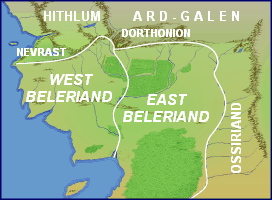 To the west of Thangorodrim lay Hisilómë, the Land of Mist, for so it was named by the Noldor in their own tongue because of the clouds that Morgoth sent thither during their first encampment; Hithlum it became in the tongue of the Sindar that dwelt in those regions. It was a fair land while the Siege of Angband lasted, although its air was cool and winter there was cold. In the west it was bounded by Ered Lómin, the Echoing Mountains that marched near the sea; and in the east and south by the great curve of Ered Wethrin, the Shadowy Mountains, that looked across Ard-galen and the Vale of Sirion.
Fingolfin and Fingon his son held Hithlum, and the most part of Fingolfin's folk dwelt in Mithrim about the shores of the great lake; to Fingon was assigned Dor-lómin, that lay to the west of the Mountains of Mithrim. But their chief fortress was at Eithel Sirion in the east of Ered Wethrin, whence they kept watch upon Ard-galen; and their cavalry rode upon that plain even to the shadow of Thangorodrim, for from few their horses had increased swiftly, and the grass of Ard-galen was rich and green. Of those horses many of the sires came from Valinor, and they were given to Fingolfin by Maedhros in atonement of his losses, for they had been carried by ship to Losgar.
West of Dor-lómin, beyond the Echoing Mountains, which south of the Firth of Drengist marched inland, lay Nevrast, that signifies the Hither Shore in the Sindarin tongue. That name was given at first to all the coast-lands south of the Firth, but afterwards only to the land whose shores lay between Drengist and Mount Taras. There for many years was the realm of Turgon the wise, son of Fingolfin, bounded by the sea, and by Ered Lómin, and by the hills which continued the walls of Ered Wethrin westward, from Ivrin to Mount Taras, which stood upon a promontory. By some Nevrast was held to belong rather to Beleriand than to Hithlum, for it was a milder land, watered by the wet winds from the sea and sheltered from the cold north winds that blew over Hithlum. It was a hollow land, surrounded by mountains and great coast-cliffs higher than the plains behind, and no river flowed thence; and there was a great mere in the midst of Nevrast, with no certain shores, being encircled by wide marshes. Linaewen was the name of that mere, because of the multitude of birds that dwelt there, of such as love tall reeds and shallow pools. At the coming of the Noldor many of the Grey-elves lived in Nevrast near to the coasts, and especially about Mount Taras in the south-west; for to that place Ulmo and Ossë had been wont to come in days of old. All that people took Turgon for their lord, and the mingling of the Noldor and the Sindar came to pass soonest there; and Turgon dwelt long in those halls that he named Vinyamar, under Mount Taras beside the sea.
South of Ard-galen the great highland named Dorthonion stretched for sixty leagues from west to east; great pine forests it bore, especially on its northern and western sides. By gentle slopes from the 'plain it rose to a bleak and lofty land, where lay many tarns at the feet of bare tors whose heads were higher than the peaks of Ered Wethrin; but southward where it looked towards Doriath it fell suddenly in dreadful precipices. From the northern slopes of Dorthonion Angrod and Aegnor, sons of Finarfin, looked out over the fields of Ard-galen, and were the vassals of their brother Finrod, lord of Nargothrond; their people were few, for the land was barren, and the great highlands behind were deemed to be a bulwark that Morgoth would not lightly seek to cross.
Between Dorthonion and the Shadowy Mountains there was a narrow vale, whose sheer walls were clad with pines; but the vale itself was green, for the River Sirion flowed through it, hastening towards Beleriand. Finrod held the Pass of Sirion, and upon the isle of Tol Sirion in the midst of the river he built a mighty watch-tower, Minas Tirith; but after Nargothrond was made he committed that fortress mostly to the keeping of Orodreth his brother.
Now the great and fair country of Beleriand lay on either side of the mighty river Sirion, renowned in song, which rose at Eithel Sirion and skirted the edge of Ard-galen ere he plunged through the pass, becoming ever fuller with the streams of the mountains. Thence he flowed south for one hundred and thirty leagues, gathering the waters of many tributaries, until with a mighty flood he reached his many mouths and sandy delta in the Bay of Balar. And following Sirion from north to south there lay upon the right hand m West Beleriand the Forest of Brethil between Sirion and Teiglin, and then the realm of Nargothrond, between Teiglin and Narog. And the River Narog rose in the falls of Ivrin in the southern face of Dor-lómin, and flowed some eighty leagues ere he joined Sirion in Nan-tathren, the Land of Willows. South of Nan-tathren was a region of meads filled with many flowers, where few folk dwelt; and beyond lay the marshes and isles of reed about the mouths of Sirion, and the sands of his delta empty of all living things save birds of the sea.
But the realm of Nargothrond extended also west of Narog to the River Nenning, that reached the sea at Eglarest; and Finrod became the overlord of all the Elves of Beleriand between Sirion and the sea, save only in the Falas. There dwelt those of the Sindar who still loved ships, and Círdan the shipbuilder was their lord; but between Círdan and Finrod there was friendship and alliance, and with the aid of the Noldor the havens of Brithombar and Eglarest were built anew. Behind their great walls they became fair towns and harbours with quays and piers of stone. Upon the cape west of Eglarest Finrod raised the tower of Barad Nimras to watch the western sea, though needlessly, as it proved; for at no time ever did Morgoth essay to build ships or to make war by sea. Water all his servants shunned, and to the sea none would willingly go nigh, save in dire need. With the aid of the Elves of the Havens some of the folk of Nargothrond built new ships, and they went forth and explored the great Isle of Balar, thinking there to prepare a last refuge, if evil came; but it was not their fate that they should ever dwell there.
Thus the realm of Finrod was the greatest by far, though he was the youngest of the great lords of the Noldor, Fingolfin, Fingon, and Maedhros, and Finrod Felagund. But Fingolfin was held overlord of all the Noldor, and Fingon after him, though their own realm was but the northern land of Hithlum; yet their people were the most hardy and valiant, most feared by the Orcs and most hated by Morgoth.
Upon the left hand of Sirion lay East Beleriand, at its widest a hundred leagues from Sirion to Gelion and the borders of Ossiriand; and first, between Sirion and Mindeb, lay the empty land of Dimbar under the peaks of the Crissaegrim, abode of eagles. Between Mindeb and the upper waters of Esgalduin lay the no-land of Nan Dungortheb; and that region was filled with fear, for upon its one side the power of Melian fenced the north march of Doriath, but upon the other side the sheer precipices of Ered Gorgoroth, Mountains of Terror, fell down from high Dorthonion. Thither, as was earlier told, Ungoliant had fled from the whips of the Balrogs, and there she dwelt a while, filling the ravines with her deadly gloom, and there still, when she had passed away, her foul offspring lurked and wove their evil nets; and the thin waters that spilled from Ered Gorgoroth were defiled, and perilous to drink, for the hearts of those that tasted them were filled with shadows of madness and despair. All living things else shunned that land, and the Noldor would pass through Nan Dungortheb only at great need, by paths near to the borders of Doriath and furthest from the haunted hills. That way was made long before, in the time ere Morgoth returned to Middle-earth; and if one fared upon it he came eastwards to Esgalduin, where still there stood in the days of the Siege the stone bridge of Iant Taur. Thence he passed through Dor Dínen, the Silent Land, and crossing the Arossiach (which signifies the Fords of Aros) came to the north marches of Beleriand, where dwelt the sons of Fëanor.
Southward lay the guarded woods of Doriath, abode of Thingol the Hidden King, into whose realm none passed save by his will. Its northern and lesser part, the Forest of Neldoreth, was bounded east and south by the dark river Esgalduin, which bent westward in the midst of the land; and between Aros and Esgalduin lay the denser and greater woods of Region. Upon the southern bank of Esgalduin, where it turned westward towards Sirion, were the Caves of Menegroth; and all Doriath lay east of Sirion save for a narrow region of woodland between the meeting of Teiglin and Sirion and the Meres of Twilight. By the people of Doriath this wood was called Nivrim, the West March; great oak-trees grew there, and it also was encompassed within the Girdle of Melian, that so some portion of Sirion which she loved in reverence of Ulmo should be wholly under the power of Thingol.
In the south-west of Doriath, where Aros flowed into Sirion, lay great pools and marshes on either side of the river, which halted there in his course and strayed in many channels. That region was named Aelin-uial, the Twilight Meres, for they were wrapped in mists, and the enchantment of Doriath lay over them. Now all the northern part of Beleriand sloped southward to this point and then for a while was plain, and the flood of Sirion was stayed. But south of Aelin-uial the land fell suddenly and steeply; and all the lower fields of Sirion were divided from the upper fields by this fall, which to one looking from the south northward appeared as an endless chain of hills running from Eglarest beyond Narog in the west to Amon Ereb in the east, within far sight of Gelion. Narog came through these hills in a deep gorge, and flowed over rapids bat had no fall, and on its western bank the land rose into the great wooded highlands of Tauren-Faroth. On the west side of this gorge, where the short and foaming stream Ringwil tumbled headlong into Narog from the High Faroth, Finrod established Nargothrond. But some twenty-five leagues east of the gorge of Nargothrond Sirion fell from the north in a mighty fall below the Meres, and then he plunged suddenly underground into great tunnels that the weight of his falling waters delved; and he issued again three leagues southward with great noise and smoke through rocky arches at the foot of the hills which were called the Gates of Sirion.
This dividing fall was named Andram, the Long Wall, from Nargothrond to Ramdal, the Wall's End, in East Beleriand. But in the east it became ever less sheer, for the vale of Gelion sloped steadily southward, and Gelion had neither fall nor rapids throughout his course, but was ever swifter than was Sirion. Between Ramdal and Gelion there stood a single hill of great extent and gentle slopes, but seeming mightier than it was, for it stood alone; and that hill was named Amon Ereb. Upon Amon Ereb died Denethor, lord of the Nandor that dwelt in Ossiriand, who marched to the aid of Thingol against Morgoth in those days when the Orcs first came down in force, and broke the starlit peace of Beleriand; and upon that hill Maedhros dwelt after the great defeat. But south of the Andram, between Sirion and Gelion, was a wild land of tangled forest in which no folk went, save here and there a few Dark Elves wandering; Taur-im-Duinath it was named, the Forest between the Rivers.
Gelion was a great river; and he rose in two sources and had at first two branches; Little Gelion that came from the Hill of Himring, and Greater Gelion that came from Mount Rerir. From the meeting of his arms he flowed south for forty leagues before he found his tributaries; and before he found the sea he was twice as long as Sirion, though less wide and full, for more rain fell in Hithlum and Dorthonion, whence Sirion drew his waters, than in the east. From Ered Luin flowed the six tributaries of Gelion: Ascar (that was after named Rathlóriel), Thalos, Legolin, Brilthor, Duilwen, and Adurant, swift and turbulent streams, falling steeply from the mountains; and between Ascar in the north and Adurant in the south, and between Gelion and Ered Luin, lay the far green country of Ossiriand, the Land of Seven Rivers. Now at a point nearly midway in its course the stream of Adurant divided and then joined again; and the island that its waters enclosed was named Tol Galen, the Green Isle. There Beren and Lúthien dwelt after their return.
In Ossiriand dwelt the Green-elves, in the protection of their rivers; for after Sirion Ulmo loved Gelion above all the waters of the western world. The woodcraft of the Elves of Ossiriand was such that a stranger might pass through their land from end to end and see none of them. They were clad in green in spring and summer, and the sound of their singing could be heard even across the waters of Gelion; wherefore the Noldor named that country Lindon, the land of music, and the mountains beyond they named Ered Lindon, for they first saw them from Ossiriand.
East of Dorthonion the marches of Beleriand were most open to attack, and only hills of no great height guarded the vale of Gelion from the north. In that region, upon the March of Maedhros and in the lands behind, dwelt the sons of Fëanor with many people; and their riders passed often over the vast northern plain, Lothlann the wide and empty, east of Ard-galen, lest Morgoth should attempt any sortie towards Bast Beleriand. The chief citadel of Maedhros was upon the Hill of Himring, the Ever-cold; and that was wide-shouldered, bare of trees, and flat upon its summit, surrounded by many lesser hills. Between Himring and Dorthonion there was a pass, exceeding steep upon the west, and that was the Pass of Aglon, and was a gate unto Doriath; and a bitter wind blew ever through it from the north. But Celegorm and Curufin fortified Aglon and held it with great strength, and all the land of Himlad southward between the River Aros that rose in Dorthonion and his tributary Celon that came from Himring.
Between the arms of Gelion was the ward of Maglor, and here in one place the hills failed altogether: there it was that the Orcs came into East Beleriand before the Third Battle. Therefore the Noldor held strength of cavalry In the plains at that place; and the people of Caranthir fortified the mountains to the east of Maglor's Gap. There Mount Rerir, and about it many lesser heights, stood out from the main range of Ered Lindon westward; and in the angle between Rerir and Ered Lindon there was a lake, shadowed by mountains on all sides save the south. That was Lake Helevorn, deep and dark, and beside it Caranthir had his abode; but all the great land between Gelion and the mountains, and between Rerir and the River Ascar, was called by the Noldor Thargelion, which signifies the Land beyond Gelion, or Dor Caranthir, the Land of Caranthir; and it was here that the Noldor first met the Dwarves. But Thargelion was before called by the Grey-elves Talath Rhúnen, the East Vale.
Thus the sons of Fëanor under Maedhros were the lords of East Beleriand, but their people were in that time mostly in the north of the land, and southward they rode only to hunt in the greenwoods. But there Amrod and Amras had their abode, and they came seldom northward while the Siege lasted; and there also other of the Elf-lords would ride at times, even from afar, for the land was wild but very fair. Of these Fin-rod Felagund came most often, for he had great love of wandering and he came even into Ossiriand, and won the friendship of the Green-elves. But none of the Noldor went ever over Ered Lindon, while their realm lasted; and little news and late came into Beleriand of what passed in the regions of the East.
QUENTA SILMARILLION
Chapter 18
Of the Ruin of Beleriand and the Fall of Fingolfin
[...]
Now news came to Hithlum that Dorthonion was lost and the sons of Finarfin overthrown, and that the sons of Fëanor were driven from their lands. Then Fingolfin beheld (as it seemed to him) the utter ruin of the Noldor, and the defeat beyond redress of all their houses; and filled with wrath and despair he mounted upon Rochallor his great horse and rode forth alone, and none might restrain him. He passed over Dor-nu-Fauglith like a wind amid the dust, and all that beheld his onset fled in amaze, thinking that Oromë himself was come: for a great madness of rage was upon him, so that his eyes shone like the eyes of the Valar. Thus he came alone to Angband's gates, and he sounded his horn, and smote once more upon the brazen doors, and challenged Morgoth to come forth to single combat. And Morgoth came.
That was the last time in those wars that he passed the doors of his stronghold, and it is said that he took not the challenge willingly; for though his might was greatest of all things in this world, alone of the Valar he knew fear. But he could not now deny the challenge before the face of his captains; for the rocks rang with the shrill music of Fingolfin's horn, and his voice came keen and clear down into the depths of Angband; and Fingolfin named Morgoth craven, and lord of slaves. Therefore Morgoth came, climbing slowly from his subterranean throne, and the rumour of his feet was like thunder underground. And he issued forth clad in black armour; and he stood before the King like a tower, iron-crowned, and his vast shield, sable on-blazoned, cast a shadow over him like a stormcloud. But Fingolfin gleamed beneath it as a star; for his mail was overlaid with silver, and his blue shield was set with crystals; and he drew his sword Ringil, that glittered like ice.
Then Morgoth hurled aloft Grond, the Hammer of the Underworld, and swung it down like a bolt of thunder. But Fingolfin sprang aside, and Grond rent a mighty pit in the earth, whence smoke and fire darted. Many times Morgoth essayed to smite him, and each time Fingolfin leaped away, as a 'lightning shoots from under a dark cloud; and he wounded Morgoth with seven wounds, and seven times Morgoth gave a cry of anguish, whereat the hosts of Angband fell upon their faces in dismay, and the cries echoed in the Northlands.
But at the last the King grew weary, and Morgoth bore down his shield upon hint Thrice he was crushed to his knees, and thrice arose again and bore up his broken shield and stricken helm. But the earth was all rent and pitted about him, and he stumbled and fell backward before the feet of Morgoth; and Morgoth set his left foot upon his neck, and the weight of it was like a fallen hill. Yet with his last and desperate stroke Fingolfin hewed the foot with Ringil, and the blood gashed forth black and smoking and filled the pits of Grond.
Thus died Fingolfin, High King of the Noldor, most proud and valiant of the Elven-kings of old. The Orcs made no boast of that duel at the gate; neither do the Elves sing of it, for their sorrow is too deep. Yet the tale of it is remembered still, for Thorondor King of Eagles brought the tidings to Gondolin, and to Hithlum afar off. And Morgoth took the body of the Elven-king and broke it, and would cast it to his wolves; but Thorondor came hasting from his eyrie among the peaks of the Crissaegrim, and he stooped upon Morgoth and marred his face. The rushing of the wings of Thorondor was like the noise of the winds of Manwë, and he seized the body in his mighty talons, and soaring suddenly above the darts of the Orcs he bore the King away. And he laid him upon a mountain-top that looked from the north upon the hidden valley of Gondolin; and Turgon coming built a high cairn over his father. No Orc dared ever after to pass over the mount of Fingolfin or draw nigh his tomb, until the doom of Gondolin was come and treachery was born among his kin. Morgoth went ever halt of one foot after that day, and the pain of his wounds could not be healed; and in his face was the scar that Thorondor made.
Great was the lamentation in Hithlum when the fall of Fingolfin became known, and Fingon in sorrow took the lordship of the house of Fingolfin and the kingdom of the Noldor; but his young son Ereinion (who was after named Gil-galad) he sent to the Havens.
[...]
QUENTA SILMARILLION
Chapter 19
Of Beren and Lúthien
Among the tales of sorrow and of ruin that come down to us from the darkness of those days there are yet some in which amid weeping there is joy and under the shadow of death light that endures. And of these histories most fair still in the ears of the Elves is the tale of Beren and Lúthien. Of their lives was made the Lay of Leithian, Release from Bondage, which is the longest save one of the songs concerning the world of old; but here is told in fewer words and without song.
It has been told that Barahir would not for sake Dorthonion, and there Morgoth pursued him to his death, until at last there remained to him only twelve companions. Now the forest of Dorthonion rose southward into mountainous moors; and in the east of those highlands there lay a lake, Tarn Aeluin, with wild heaths about it, and all that land was pathless and untamed, for even in the days of the Long Peace none had dwelt there. But the waters of Tarn Aeluin were held in reverence, for they were clear and blue by day and by night were a mirror for the stars; and it was said that Melian herself had hollowed that water in the days of old. Thither Barahir and his outlaws withdrew, and there made their lair, and Morgoth could not discover it. But the rumour of the deeds of Barahir and his companions went far and wide; and Morgoth commanded Sauron to find them and destroy them.
Now among the companions of Barahir was Gorlim son of Angrim. His wife was named Eilinel, and their love was great, ere evil befell. But Gorlim returning from the war upon the marches found his house plundered and forsaken, and his wife gone; whether slain or taken he knew not. Then he fled to Barahir, and of companions his he was the most fierce and desperate; but doubt gnawed his heart, thinking that perhaps Eilinel was not dead. At times he would depart alone and secretly, and visit his house that stood amid the fields and woods he had once possessed; and this became known to the servants of Morgoth.
On a time of autumn he came in the dusk of evening, and drawing near he saw as he thought a light at the window; and coming warily he looked within. There he saw Eilinel, and her face was worn with grief and hunger, and it seemed to him that he heard her voice lamenting that he had forsaken her. But even as he cried aloud the light was blown out in the wind; wolves howled, and on his shoulders he felt suddenly the heavy hands of Sauron's hunters. Thus Gorlim was ensnared; and taking him to their camp they tormented, seeking to learn the hidings of Barahir and all his ways. But nothing would Gorlim tell. Then they promised him that he should be released and restored to Eilinel, if he would yield; and being at last worn with pain, and yearning for his wife, he faltered. Then straightaway they brought him into the dreadful presence of Sauron; and Sauron said: 'I hear now that thou wouldst barter with me. What is thy price?'
And Gorlim answered that he should find Eilinel again, and with her be set free; for he thought Eilinel also had been made captive.
Than Sauron smiled, saying: 'That is a small price for so great a treachery. So shall it surely be. Say on!'
Now Gorlim would have drawn back, but daunted by the eyes of Sauron he told at last all that he would know. Then Sauron laughed; and he mocked Gorlim, and revealed to him that he had only seen a phantom devised by wizardry to entrap him; for Eilinel was dead. 'Nonetheless I will grant thy prayer,' said Sauron; 'and thou shalt go to Eilinel, and be set free of my service.' Then he put him cruelly to death.
In this way the hiding of Barahir was revealed, and Morgoth drew his net about it; and the Orcs coming in the still hours before dawn surprised the men of Dorthonion and slew them all, save one. For Beren son of Barahir had been sent by his father on a perilous errand to spy upon the ways of the Enemy, and he was far afield when the lair was taken. But as he slept benighted in the forest he dreamed that carrion-birds sat thick as leaves upon bare trees beside a mere, and blood dripped from their beaks.
Then Beren was aware in his dream of a form that came to him across the water, and it was a wraith of Gorlim; and it spoke to him declaring his treachery and death, and bade him make haste to warn his father. Then Beren awoke, and sped through the night, and came back to the lair of the outlaws on the second morning. But as he drew near the carrion-birds rose from the ground and sat in the alder-trees beside Tarn Aeluin, and croaked in mockery.
There Beren buried his fathers bones, and raised a cairn of boulders above him, and swore upon it an oath of vengeance. First there for he pursued the Orcs that had slain his father and his kinsmen, and he found their camp by night at Rivil's Well above the Fen of Serech, and because of his wood craft he came near to their fire unseen. There their captain made boast of his deeds, and he held up the hand of Barahir that he had cut off as a token for Sauron that their mission was fulfilled; and the ring of Felagund was on that hand. Then Beren sprang from behind rock, and slew captain, and taking the hand and the ring he escaped, being defended by fate for the Orcs were dismayed, and their arrows wild.
[...]
The Singers' Combat
He chanted a song of wizardry,
Of piercing, opening, of treachery,
Revealing, uncovering, betraying.
Then sudden Felagund there swaying,
Sang in a song of staying,
Resisting, battling against power,
Of secrets kept, strength like a tower,
And trust unbroken, freedom, escape;
Of changing and shifting shape,
Of snares eluded, broken traps,
The prison opening, the chain that snaps.
Backwards and forwards swayed their song.
Reeling foundering, as ever more strong
The chanting swelled, Felagund fought,
And all the magic and might he brought
Of Elvenesse into his words.
Softly in the gloom they heard the birds
Singing afar in Nargothrond,
The sighting of the Sea beyond,
Beyond the western world, on sand,
On sand of pearls on Elvenland.
Then in the doom gathered; darkness growing
In Valinor, the red blood flowing
Beside the Sea, where the Noldor slew
The Foamriders, and stealing drew
Their white ships with their white sails
From lamplit havens. The wind wails,
The wolf howls. The ravens flee.
The ice mutters in the mouths of the Sea.
The captives sad in Angband mourn.
Thunder rumbles, the fires burn-
And Finrod fell before the throne.
[...]
Song of Parting
Farewell sweet earth and northern sky,
for ever blest, since here did lie
and here with lissom limbs did run
beneath the Moon, beneath the Sun,
Lúthien Tinúviel
more fair than mortal tongue can tell.
Though all to ruin fell the world
and were dissolved and backward hurled
unmade into the old abyss,
yet were its making good, for this-
the dusk, the dawn, the earth, the sea-
that Lúthien for a time should be.
[...]
QUENTA SILMARILLION
Chapter 21
Of Túrin Turambar
[...]
Túrin grew fair and strong in Doriath, but he was marked with sorrow. For nine years he dwelt in Thingol's halls, and during that time his grief grew less; for messengers went at times to Hithlum, and returning they brought better tidings of Morwen and Nienor.
But there came a day when the messengers did not return out of die north, and Thingol would send no more. Then Túrin was filled with fear for his mother and his sister, and in grimness of heart he went before the King and asked for mail and sword; and he put on the Dragon-helm of Dor-lómin and went out to battle on the marches of Doriath, and became the companion in arms of Beleg Cúthalion.
And when three years had passed, Túrin returned again to Menegroth; but he came from the wild, and was unkempt, and his gear and garments were way-worn. Now one there was in Doriath, of the people of the Nandor, high in the counsels of the King; Saeros was his name. He had long begrudged to Túrin the honour he received as Thingol's fosterson; and seated opposite to him at the board he taunted him, saying:
'If the Men of Hithlum are so wild and fell, of what sort are the women of that land? Do they run like deer clad only in their hair?' Then Túrin in great anger took up a drinking-vessel, and cast it at Saeros; and he was grievously hurt.
On the next day Saeros waylaid Túrin as he set out from Menegroth to return to the marches; but Túrin overcame him, and set him to run naked as a hunted beast through the woods. Then Saeros fleeing in terror before him fell into the chasm of a stream, and his body was broken on a great rock in the water. But others coming saw what was done, and Mablung was among them; and he bade Túrin return with him to Menegroth and abide the judgement of the King, seeking his pardon. But Túrin, deeming himself now an outlaw and fearing to be held captive, refused Mablung's bidding, and turned swiftly away; and passing through the Girdle of Melian he came into the woods west of Sirion. There he joined himself to a band of such houseless and desperate men as could be found in those evil days lurking in the wild; and their hands were turned against all who came in their path Elves and Men and Orcs.
But when all that had befallen was told and searched out before Thingol, the King pardoned Túrin, holding him wronged. In that time Beleg Strongbow returned from the north marches and came to Menegroth, seeking him; and Thingol spoke to Beleg, saying: 'I grieve, Cúthalion; for I took Húrin's son as my son, and so he shall remain, unless Húrin himself should return out of the shadows to claim his own. I would not have any say that Túrin was driven forth unjustly into the wild, and gladly would I welcome him back; for I loved him well.'
And Beleg answered: 'I will seek Túrin until I find him, and I will bring him back to Menegroth, if I can; for I love him also.'
Then Beleg departed from Menegroth, and far across Beleriand he sought in vain for tidings of Túrin through many perils.
[...]
Now new tidings came to Doriath concerning Nargothrond, for some that had escaped from the defeat and the sack, and had survived the Fell Winter in the wild, came at last to Thingol seeking refuge; and the march-wardens brought them to the King. And some said that all the enemy had withdrawn northwards, and others that Glaurung abode still in the halls of Felagund; and some said that the Mormegil was slain, and others that he was cast under a spell by the dragon and dwelt there yet, as one changed to stone. But all declared that it was known to many in Nargothrond ere the end that the Mormegil was none other than Túrin son of Húrin of Dor-lómin.
Then Morwen was distraught, and refusing the counsel of Melian she rode forth alone into the wild to seek her son, or some true tidings of him. Thingol therefore sent Mablung after her, with many hardy march-wards, to find her and guard her, and to learn what news they might; but Nienor was bidden to remain behind. Yet the fearlessness of her house was hers; and in an evil hour, in hope that Morwen would return when she saw that her daughter would go with her into peril, Nienor disguised herself as one of Thingol's people, and went with that ill-fated riding.
They came upon Morwen by the banks of Sirion, and Mablung besought her to return to Menegroth; but she was fey, and would not be persuaded. Then also the coming of Nienor was revealed, and despite Morwen's command she would not go back; and Mablung perforce brought them to the hidden ferries at the Meres of Twilight, and they passed over Sirion. And after three days' journeying they came to Amon Ethir, the Hill of Spies, that long ago Felagund had caused to be raised with great labour, a league before the doors of Nargothrond. There Mablung set a guard of riders about Morwen and her daughter, and forbade them to go further. But he, seeing from the hill no sign of any enemy, went down with his scouts to the Narog, as stealthily as they could go.
But Glaurung was aware of all that they did, and he came forth in heat of wrath, and lay into the river; and a vast vapour and foul reek went up, in which Mablung and his company were blinded and lost Then Glaurung passed east over Narog.
Seeing the onset of the dragon the guards upon Amon Ethir sought to lead Morwen and Nienor away, and fly with them with all speed back eastwards; but the wind bore the blank mists upon them, and their horses were maddened by the dragon-stench, and were ungovernable, and ran this way and that, so that some were dashed against trees and were slain, and others were borne far away. Thus the ladies were lost, and of Morwen indeed no sure tidings came ever to Doriath after. But Nienor, being thrown by her steed, yet unhurt, made her way back to Amon Ethir, there to await Mablung, and came thus above the reek into the sunlight; and looking westward she stared straight into the eyes of Glaurung, whose head lay upon the hill-top.
Her will strove with him for a while, but he put forth his power, and having learned who she was he constrained her to gaze into his eyes, and he laid a spell of utter darkness and forgetfulness upon her, so that she could remember nothing that had ever befallen her, nor her own name, nor the name of any other thing; and for many days she could neither hear, nor see, nor stir by her own will. Then Glaurung left her standing alone upon Amon Ethir, and went back to Nargothrond.
[...]
Then Túrin set the hilts upon the ground, and cast himself upon the point of Gurthang, and the black blade took his life. But Mablung and the Elves came and looked on the shape of Glaurung lying dead, and upon the body of Túrin, and they grieved; and when Men of Brethil came thither, and they learned the reasons of Túrin's madness and death, they were aghast; and Mablung said bitterly: 'I also have been meshed in the doom of the Children of Húrin, and thus with my tidings have slain one that I loved.'
Then they lifted up Túrin, and found that Gurthang had broken asunder. But Elves and Men gathered there great store of wood, and they made a mighty burning, and the Dragon was consumed to ashes. Túrin they laid in a high mound where he had fallen, and the shards of Gurthang were laid beside him. And when all was done, the Elves sang a lament for the Children of Húrin, and a great grey stone was set upon the mound, and thereon was carven in runes of Doriath:
TÚRIN TURAMBAR DAGNIR GLAURUNGA
and beneath they wrote also:
NIENOR N1NIEL
But she was not there, nor was it ever known whither the cold waters of Teiglin had taken her.
QUENTA SILMARILLION
Chapter 24
Of the Voyage of Eärendil and the War of Wrath
Bright Eärendil was then lord of the people that dwelt nigh to Sirion's mouths; and he took to wife Elwing the fair, and she bore to him Elrond and Elros, who are called the Half-elven. Yet Eärendil could not rest, and his voyages about the shores of the Hither Lands eased not his unquiet. Two purposes grew in his heart, blended as one in longing for the wide Sea: he sought to sail thereon, seeking after Tuor and Idril who returned not; and he thought to find perhaps the last shore, and bring ere he died the message of Elves and Men to the Valar in the West, that should move their hearts to pity for the sorrows of Middle-earth.
Now Eärendil became fast in friendship with Círdan the Shipwright, who dwelt on the Isle of Balar with those of his people who escaped from the sack of the Havens of Brithombar and Eglarest. With the aid of Círdan Eärendil built Vingilot, the Foam-flower, fairest of the ships of song; golden were its oars and white its timbers, hewn in the birchwoods of Nimbrethil, and its sails were as the argent moon. In the Lay of Eärendil is many a thing sung of his adventures in the deep and in lands untrodden, and in many seas and in many isles; but Elwing was not with him, and she sat in sorrow by the mouths of Sirion.
Eärendil found not Tuor nor Idril, nor came he ever on that journey to the shores of Valinor, defeated by shadows and enchantment, driven by repelling winds, until in longing for Elwing he turned homeward towards the coast of Beleriand. And his heart bade him haste, for a sudden fear had fallen on him out of dreams; and the winds that before he had striven with might not now bear him back as swift as his desire.
[...]
Yet Eärendil saw now no hope left in the lands of Middle-earth, and he turned again in despair and came not home, but sought back once more to Valinor with Elwing at his side. He stood now most often at the prow of Vingilot, and the Silmaril was bound upon his brow; and ever its light grew greater as they drew into the West. And the wise have said that it was by reason of the power of that holy jewel that they came in time to waters that no vessels save those of the Teleri had known; and they came to the Enchanted Isles and escaped their enchantment; and they came into the Shadowy Seas and passed their shadows, and they looked upon Tol Eressëa the Lonely Isle, but tarried not; and at the last they cast anchor in the Bay of Eldamar, and the Teleri saw the coming of that ship out of the East and they were amazed, gazing from afar upon the light of the Silmaril, and it was very great. Then Eärendil, first of living Men, landed on the immortal shores; and he spoke there to Elwing and to those that were with him, and they were three mariners who had sailed all the seas besides him: Falathar, Erellont, and Aerandir were their names. And Eärendil said to them: 'Here none but myself shall set foot, lest you fall under the wrath of the Valar. But that peril I will take on myself alone, for the sake of the Two Kindreds.'
But Elwing answered: 'Then would our paths be sundered for ever; but all thy perils I will take on myself also.' And she leaped into the white foam and ran towards him; but Eärendil was sorrowful, for he feared the anger of the Lords of the West upon any of Middle-earth that should dare to pass the leaguer of Aman. And there they bade farewell to the companions of their voyage, and were taken from them for ever.
Then Eärendil said to Elwing: 'Await me here; for one only may bring the message that it is my fate to bear.' And he went up alone into the land, and came into the Calacirya, and it seemed to him empty and silent; for even as Morgoth and Ungoliant came in ages past, so now Eärendil had come at a time of festival, and wellnigh all the Elvenfolk were gone to Valimar, or were gathered in the halls of Manwë upon Taniquetil, and few were left to keep watch upon the walls of Tirion.
But some there were who saw him from afar, and the great light that he bore; and they went in haste to Valimar. But Eärendil climbed the green hill of Túna and found it bare; and he entered into the streets of Tirion, and they were empty; and his heart was heavy, for he feared that some evil had come even to the Blessed Realm. He walked in the deserted ways of Tirion, and the dust upon his raiment and his shoes was a dust of diamonds, and he shone and glistened as he climbed the long white stairs. And he called aloud in many tongues, both of Elves and Men, but there were none to answer him. Therefore he turned back at last towards the sea; but even as he took the shoreward road one stood upon the hill and called to him in a great voice, crying:
'Hail Eärendil, of mariners most renowned, the looked for that cometh at unawares, the longed for that cometh beyond hope! Hail Eärendil, bearer of light before the Sun and Moon! Splendour of the Children of Earth, star in the darkness, jewel in the sunset, radiant in the morning!'
That voice was the voice of Eönwë, herald of Manwë, and he came from Valimar, and summoned Eärendil to come before the Powers of Arda. And Eärendil went into Valinor and to the halls of Valimar, and never again set foot upon the lands of Men.
[...]
Here ends the SILMARILLION. If it has passed from the high and the beautiful to darkness and ruin, that was of old the fate of Arda Marred; and if any change shall come and the Marring be amended, Manwë and Varda may know; but they have not revealed it, and it is not declared in the dooms of Mandos.
AKALLABÊTH
The Downfall of Númenor
[...]
A land was made for the Edain to dwell in, neither part of Middle-earth nor of Valinor, for it was sundered from either by a wide sea; yet it was nearer to Valinor. It was raised by Ossë out of the depths of the Great Water, and it was established by Aulë and enriched by Yavanna; and the Eldar brought thither flowers and fountains out of Tol Eressëa. That land the Valar called Andor, the Land of Gift; and the Star of Eärendil shone bright in the West as a token that all was made ready, and as a guide over the sea; and Men marvelled to see that silver flame in the paths of the Sun.
Then the Edain set sail upon the deep waters, following the Star; and the Valar laid a peace upon the sea for many days, and sent sunlight and a sailing wind, so that the waters glittered before the eyes of the Edain like rippling glass, and the foam flew like snow before the stems of their ships. But so bright was Rothinzil that even at morning Men could see it glimmering in the West, and in the cloudless night it shone alone, for no other star could stand beside it. And setting their course towards it the Edain came at last over leagues of sea and saw afar the land that was prepared for them, Andor, the Land of Gift, shimmering in a golden haze. Then they went up out of the sea and found a country fair and fruitful, and they were glad. And they called that land Elenna, which is Starwards; but also Anadûnë, which is Westernesse, Númenórë in the High Eldarin tongue.
This was the beginning of that people that in the Grey-elven speech are called the Dúnedain: the Númenóreans, Kings among Men. But they did not thus escape from the doom of death that Ilúvatar had set upon all Mankind, and they were mortal still, though their years were long, and they knew no sickness, ere the shadow fell upon them. Therefore they grew wise and glorious, and in all things more like to the Firstborn than any other of the kindreds of Men; and they were tall, taller than the tallest of the sons of Middle-earth; and the light of their eyes was like the bright stars. But their numbers increased only slowly in the land, for though daughters and sons were born to them, fairer than their fathers, yet their children were few.
[...]
In this Age, as is elsewhere told, Sauron arose again in Middle-earth, and grew, and turned back to the evil in which he was nurtured by Morgoth, becoming mighty in his service. Already in the days of Tar-Minastir, the eleventh King of Númenor, he had fortified the land of Mordor and had built there the Tower of Barad-dûr, and thereafter he strove ever for the dominion of Middle-earth, to become a king over all kings and as a god unto Men. And Sauron hated the Númenóreans, because of the deeds of their fathers and their ancient alliance with the Elves and allegiance to the Valar; nor did he forget the aid that Tar-Minastir had rendered to Gil-galad of old, in that time when the One Ring was forged and there was war between Sauron and the Elves in Eriador. Now he learned that the kings of Númenor had increased hi power and splendour, and he hated them the more; and he feared them, lest they should invade his lands and wrest from him the dominion of the East. But for a long time he did not dare to challenge the Lords of the Sea, and he withdrew from the coasts.
Yet Sauron was ever guileful, and it is said that among those whom he ensnared with the Nine Rings three were great lords of Númenórean race. And when the Úlairi arose that were the Ring-wraiths, his servants, and the strength of his terror and mastery over Men had grown exceedingly great, he began to assail the strong places of the Númenóreans upon the shores of the sea.
In those days the Shadow grew deeper upon Númenor; and the lives of the Kings of the House of Elros waned because of their rebellion, but they hardened their hearts the more against the Valar. And the nineteenth king took the sceptre of his fathers, and he ascended the throne in the name of Adunakhôr, Lord of the West, forsaking the Elven-tongues and forbidding their use in his hearing. Yet hi the Scroll of Kings the name Herunúmen was inscribed in the High-elven speech, because of ancient custom, which the kings feared to break utterly, lest evil befall Now this title seemed to the Faithful over-proud, being the title of the Valar; and their hearts were sorely tried between their loyalty to the House of Elros and their reverence of the appointed Powers. But worse was yet to come. For Ar-Gimilzôr the twenty-second king was the greatest enemy of the Faithful. In his day the White Tree was untended and began to decline; and he forbade utterly the use of the Elven-tongues, and punished those that welcomed the ships of Eressëa, that still came secretly to the west-shores of the land.
[...]
Great was the anger of Ar-Pharazôn at these tidings, and as he pondered long in secret, his heart was filled with the desire of power unbounded and the sole dominion of his will. And he determined without counsel of the Valar, or the aid of any wisdom but his own, that the title of King of Men he would himself claim, and would compel Sauron to become his vassal and his servant; for in his pride he deemed that no king should ever arise so mighty as to vie with the Heir of Eärendil. Therefore he began in that time to smithy great hoard of weapons, and many ships of war he built and stored them with his arms; and when all was made ready he himself set sail with his host into the East.
And men saw his sails coming up out of the sunset, dyed as with scarlet and gleaming with red and gold, and fear fell upon the dwellers by the coasts, and they fled far away. But the fleet came at last to that place that was called Umbar, where was the mighty haven of the Númenóreans that no hand had wrought. Empty and silent were all the lands about when the King of the Sea marched upon Middle-earth. For seven days he journeyed with banner and trumpet, and he came to a hill, and he went up, and he set there his pavilion and his throne; and he sat him down in the midst of the land, and the tents of his host were ranged all about him, blue, golden, and white, as a field of tall flowers. Then he sent forth heralds, and he commanded Sauron to come before him and swear to him fealty.
And Sauron came.
[...]
And Ar-Pharazôn said: 'Who is the Lord of the Darkness?'
Then behind locked doors Sauron spoke to the King, and he lied, saying: 'It is he whose name is not now spoken; for the Valar have deceived you concerning him, putting forward the name of Eru, a phantom devised in the folly of their hearts, seeking to enchain Men in servitude to themselves. For they are the oracle of this Eru, which speaks only what they will. But he that is their master shall yet prevail, and he will deliver you from this phantom; and his name is Melkor, Lord of All, Giver of Freedom, and he shall make you stronger than they.'
Then Ar-Pharazôn the King turned back to the worship of the Dark, and of Melkor the Lord thereof, at first in secret, but ere long openly and in the face of his people; and they for the most part followed him. Yet there dwelt still a remnant of the Faithful, as has been told, at Romenna and in the country near, and other few there were here and there in the land. The chief among them, to whom they looked for leading and courage in evil days, was Amandil, councillor of the King, and his son Elendil, whose sons were Isildur and Anárion, then young men by the reckoning of Númenor. Amandil and Elendil were great ship-captains; and they were of the line of Elros Tar-Minyatur, though not of the ruling house to whom belonged the crown and the throne in the city of Armenelos. In the days of their youth together Amandil had been dear to Pharazôn, and though he was of the Elf-friends he remained in his council until the coming of Sauron. Now he was dismissed, for Sauron hated him above all others in Númenor. But he was so noble, and had been so mighty a captain of the sea, that he was still held in honour by many of the people, and neither the King nor Sauron dared to lay hands on him as yet.
[...]
And he (Ar-Pharazôn) said: 'The Valar have possessed themselves of the land where there is no death; and they lie to you concerning it, hiding it as best they may, because of their avarice, and their fear lest the Kings of Men should wrest from them the deathless realm and rule the world in their stead. And though, doubtless, the gift of life unending is not for all, but only for such as are worthy, being men of might and pride and great lineage, yet against all Justice is it done that this gift, which is his due, should be withheld from the King of Bangs, Ar-Pharazôn, mightiest of the sons of Earth, to whom Manwë alone can be compared, if even he. But great kings do not brook denials, and take what is their due.'
Then Ar-Pharazôn, being besotted, and walking under the shadow of death, for his span was drawing towards its end, hearkened to Sauron; and he began to ponder in his heart how he might make war upon the Valar. He was long preparing this design, and he spoke not openly of it, yet it could not be hidden from all.
[...]
Then Ar-Pharazôn hardened his heart, and he went aboard his mighty ship, Alcarondas, Castle of the Sea. Many-oared it was and many-masted, golden and sable; and upon it the throne of Ar-Pharazôn was set. Then he did on his panoply and his crown, and let raise his standard, and he gave the signal for the raising of the anchors; and in that hour the trumpets of Númenor outrang the thunder.
Thus the fleets of the Númenóreans moved against the menace of the West; and there was little wind, but they had many oars and many strong slaves to row beneath the lash. The sun went down, and there came a great silence. Darkness fell upon the land, and the sea was still, while the world waited for what should betide. Slowly the fleets passed out of the sight of the watchers in the havens, and their lights faded, and night took them; and in the morning they were gone. For a wind arose in the east and it wafted them away; and they broke the Ban of the Valar, and sailed into forbidden seas, going up with war against the Deathless, to wrest from them everlasting life within the Circles of the World.
But the fleets of Ar-Pharazôn came up out of the deeps of the sea and encompassed Avallónë and all the isle of Eressëa, and the Eldar mourned, for the light of the setting sun was cut off by the cloud of the Númenóreans. And at last Ar-Pharazôn came even to Aman, the Blessed Realm, and the coasts of Valinor; and still all was silent, and doom hung by a thread. For Ar-Pharazôn wavered at the end, and almost he turned back. His heart misgave him when he looked upon the soundless shores and saw Taniquetil shining, whiter than snow, colder than death, silent, immutable, terrible as the shadow of the light of Ilúvatar. But pride was now his master, and at last he left his ship and strode upon the shore, claiming the land for his own, if none should do battle for it. And a host of the Númenóreans encamped in might about Túna, whence all the Eldar had fled.
[...]
Elendil and his sons after founded kingdoms in Middle-earth; and though their lore and craft was but an echo of that which had been ere Sauron came to Númenor, yet very great it seemed to the wild men of the world. And much is said in other lore of the deeds of the heirs of Elendil in the age that came after, and of their strife with Sauron that not yet was ended.
For Sauron himself was filled with great fear at the wrath of the Valar, and the doom that Eru laid upon sea and land. It was greater far than aught he had looked for, hoping only for the death of the Númenóreans and the defeat of their proud king. And Sauron, sitting in his black seat in the midst of the Temple, had laughed when he heard the trumpets of Ar-Pharazôn sounding for battle; and again he had laughed when he heard the thunder of the storm; and a third time, even as he laughed at his own thought, thinking what he would do now in the world, being rid of the Edain for ever, he was taken in the midst of his mirth, and his seat and his temple fell into the abyss. But Sauron was not of mortal flesh, and though he was robbed now of that shape in which he had wrought so great an evil, so that he could never again appear fair to the eyes of Men, yet his spirit arose out of the deep and passed as a shadow and a black wind over the sea, and came back to Middle-earth and to Mordor that was his home. There he took up again his great Ring in Barad-dûr, and dwelt there, dark and silent, until he wrought himself a new guise, an image of malice and hatred made visible; and the Eye of Sauron the Terrible few could endure.
But these things come not into the tale of the Drowning of Númenor, of which now all is told. And even the name of that land perished, and Men spoke thereafter not of Elenna, nor of Andor the Gift that was taken away, nor of Númenórë on the confines of the world; but the exiles on the shores of the sea, if they turned towards the West in the desire of their hearts, spoke of Mar-nu-Falmar that was whelmed in the waves, Akallabêth the Downfallen, Atalantë in the Eldarin tongue.
Among the Exiles many believed that the summit of the Meneltarma, the Pillar of Heaven, was not drowned for ever, but rose again above the waves, a lonely island lost in the great waters; for it had been a hallowed place, and even in the days of Sauron none had defiled it And some there were of the seed of Eärendil that afterwards sought for it, because it was said among loremasters that the far-sighted men of old could see from the Meneltarma a glimmer of the Deathless Land. For even after the ruin the hearts of the Dúnedain were still set westwards; and though they knew indeed that the world was changed, they said: 'Avallónë is vanished from the Earth and the Land of Aman is taken away, and in the world of this present darkness they cannot be found. Yet once they were, and therefore they still are, in true being and in the whole shape of the world as at first it was devised.'
For the Dúnedain held that even mortal Men, if so blessed, might look upon other times than those of their bodies' life; and they longed ever to escape from the shadows of their exile and to see in some fashion fee light that dies not; for the sorrow of the thought of death had pursued them over the deeps of the sea. Thus it was that great mariners among them would still search the empty seas, hoping to come upon the Isle of Meneltarma, and there to see a vision of things that were. But they found it not. And those that sailed far came only to the new lands, and found them like to the old lands, and subject to death. And those that sailed furthest set but a girdle about the Earth and returned weary at last to the place of their beginning; and they said:
'All roads are now bent.'
Thus in after days, what by the voyages of ships, what by lore and star-craft, the kings of Men knew that the world was indeed made round, and yet the Eldar were permitted still to depart and to come to the Ancient West and to Avallónë, if they would. Therefore the loremasters of Men said that a Straight Road must still be, for those that were permitted to find it. And they taught that, while the new world fell away, the old road and the path of the memory of the West still went on, as it were a mighty bridge invisible that passed through the air of breath and of flight (which were bent now as the world was bent), and traversed Ilmen which flesh unaided cannot endure, until it came to Tol Eressëa, the Lonely Isle, and maybe even beyond, to Valinor, where the Valar still dwell and watch the unfolding of the story of the world. And tales and rumours arose along the shores of the sea concerning mariners and men forlorn upon the water who, by some fate or grace or favour of the Valar, had entered in upon the Straight Way and seen the face of the world sink below them, and so had come to the lamplit quays of Avallónë, or verily to the last beaches on the margin of Aman, and there had looked upon the White Mountain, dreadful and beautiful, before they died.
OF THE RINGS OF POWER AND THE THIRD AGE
Of old there was Sauron the Maia, whom the Sindar in Beleriand named Gorthaur. In the beginning of Arda Melkor seduced him to his allegiance, and he became the greatest and most trusted of the servants of the Enemy, and the most perilous, for he could assume many forms, and for long if he willed he could still appear noble and beautiful, so as to deceive all but the most wary.
When Thangorodrim was broken and Morgoth overthrown, Sauron put on his fair hue again and did obeisance to Eönwë the herald of Manwë, and abjured all his evil deeds. And some hold that this was not at first falsely done, but that Sauron in truth repented, if only out of fear, being dismayed by the fall of Morgoth and the great wrath of the Lords of the West. But it was not within the power of Eönwë to pardon those of his own order, and he commanded Sauron to return to Aman and there receive the judgement of Manwë. Then Sauron was ashamed, and he was unwilling to return in humiliation and to receive from the Valar a sentence, it might be, of long servitude in proof of his good faith; for under Morgoth his power had been great. Therefore when Eönwë departed he hid himself in Middle-earth; and he fell back into evil, for the bonds that Morgoth bad laid upon him were very strong.
[...]
Elsewhere in Middle-earth there was peace for many years; yet the lands were for the most part savage and desolate, save only where the people of Beleriand came. Many Elves dwelt there indeed, as they had dwelt through the countless years, wandering free in the wide lands far from the Sea; but they were Avari, to whom the deeds of Beleriand were but a rumour and Valinor only a distant name. And in the south and in the further east Men multiplied; and most of them turned to evil, for Sauron was at work.
Seeing the desolation of the world, Sauron said in his heart that the Valar, having overthrown Morgoth, had again forgotten Middle-earth; and his pride grew apace. He looked with hatred on the Eldar, and he feared the Men of Númenor who came back at whiles in their ships to the shores of Middle-earth; but for long he dissembled his mind and concealed the dark designs that he shaped in his heart.
Men he found the easiest to sway of all the peoples of the Earth; but long he sought to persuade the Elves to his service, for he knew that the Firstborn had the greater power; and he went far and wide among them, and his hue was still that of one both fair and wise. Only to Lindon he did not come, for Gil-galad and Elrond doubted him and his fair-seeming, and though they knew not who in truth he was they would not admit him to that land. But elsewhere the Elves received him gladly, and few among them hearkened to the messengers from Lindon bidding them beware; for Sauron took to himself the name of Annatar, the Lord of Gifts, and they had at first much profit from his friendship. And he said to them: "Alas, for the weakness of the great! For a mighty king is Gil-galad, and wise in all lore is Master Elrond, and yet they will not aid me in my labours. Can it be that they do not desire to see other lands become as blissful as their own? But wherefore should Middle-earth remain for ever desolate and dark, whereas the Elves could make it as fair as Eressëa, nay even as Valinor? And since you have not returned thither, as you might, I perceive that you love this Middle-earth, as do I. Is it not then our task to labour together for its enrichment, and for the raising of all the Elven-kindreds that wander here untaught to the height of that power and knowledge which those have who are beyond the Sea?'
It was in Eregion that the counsels of Sauron were most gladly received, for in that land the Noldor desired ever to increase the skill and subtlety of their works. Moreover they were not at peace in their hearts, since they had refused to return into the West, and they desired both to stay in Middle-earth, which indeed they loved, and yet to enjoy the bliss of those that had departed. Therefore they hearkened to Sauron, and they learned of him many things, for his knowledge was great. In those days the smiths of Ost-in-Edhil surpassed all that they had contrived before; and they took thought, and they made Rings of Power. But Sauron guided their labours, and he was aware of all that they did; for his desire was to set a bond upon the Elves and to bring them under his vigilance.
Now the Elves made many rings; but secretly Sauron made One Ring to rule all the others, and their power was bound up with it, to be subject wholly to it and to last only so long as it too should last. And much of the strength and will of Sauron passed into that One Ring; for the power of the Elven-rings was very great, and that which should govern them must be a thing of surpassing potency; and Sauron forged it in the Mountain of Fire in the Land of Shadow. And while he wore the One Ring he could perceive all the things that were done by means of the lesser rings, and he could see and govern the very thoughts of those that wore them.
But the Elves were not so lightly to be caught. As soon as Sauron set the One Ring upon his finger they were aware of him; and they knew him, and perceived that he would be master of them, and of an that they wrought. Then in anger and fear they took off their rings. But he, finding that he was betrayed and that the Elves were not deceived, was filled with wrath; and he came against them with open war, demanding that all the rings should be delivered to him, since the Elven-smiths could not have attained to their making without his lore and counsel. But the Elves fled from him; and three of their rings they saved, and bore them away, and hid them.
Now these were the Three that had last been made, and they possessed the greatest powers. Narya, Nenya, and Vilya, they were named, the Rings of Fire, and of Water, and of Air, set with ruby and adamant and sapphire; and of all the Elven-rings Sauron most desired to possess them, for those who had them in their keeping could ward off the decays of time and postpone the weariness of the world. But Sauron could not discover them, for they were given into the hands of the Wise, who concealed them and never again used them openly while Sauron kept the Ruling Ring. Therefore the Three remained unsullied, for they were forged by Celebrimbor alone, and the hand of Sauron had never touched them; yet they also were subject to the One.
From that time war never ceased between Sauron and the Elves; and Eregion was laid waste, and Celebrimbor slain, and the doors of Moria were shut. In that time the stronghold and refuge of Imladris, that Men called Rivendell, was founded by Elrond Half-elven; and long it endured. But Sauron gathered into his hands all the remaining Rings of Power; and he dealt them out to the other peoples of Middle-earth, hoping thus to bring under his sway all those that desired secret power beyond the measure of their kind. Seven Rings he gave to the Dwarves; but to Men he gave nine, for Men proved in this matter as in others the readiest to his will. And all those rings that he governed he perverted, the more easily since he had a part in their making, and they were accursed, and they betrayed in the end all those that used them. The Dwarves indeed proved tough and hard to tame; they ill endure the domination of others, and the thoughts of their hearts are hard to fathom, nor can they be turned to shadows. They used their rings only for the getting of wealth; but wrath and an over-mastering greed of gold were kindled in their hearts, of which evil enough after came to the profit of Sauron. It is said that the foundation of each of the Seven Hoards of the Dwarf-kings of old was a golden ring; but all those hoards long ago were plundered and the Dragons devoured them, and of the Seven Rings some were consumed in fire and some Sauron recovered.
[...]
Now Elendil and Gil-galad took counsel together, for they perceived that Sauron would grow too strong and would overcome all his enemies one by one, if they did not unite against him. Therefore they made that League which is called the Last Alliance, and they marched east into Middle-earth gathering a great host of Elves and Men; and they halted for a while at Imladris. It is said that the host that was there assembled was fairer and more splendid in arms than any that has since been seen in Middle-earth, and none greater has been mustered since the host of the Valar went against Thangorodrim.
From Imladris they crossed the Misty Mountains by many passes and marched down the River Anduin, and so came at last upon the host of Sauron on Dagorlad, the Battle Plain, which lies before the gate of the Black Land. All living things were divided in that day, and some of every kind, even of beasts and birds, were found in either host, save the Elves only. They alone were undivided and followed Gil-galad. Of the Dwarves few fought upon either side; but the kindred of Durin of Moria fought against Sauron.
The host of Gil-galad and Elendil had the victory, for the might of the Elves was still great in those days, and the Númenóreans were strong and tall, and terrible in their wrath. Against Aeglos the spear of Gil-galad none could stand; and the sword of Elendil filled Orcs and Men with fear, for it shone with the light of the sun and of the moon, and it was named Narsil.
Then Gil-galad and Elendil passed into Mordor and encompassed the stronghold of Sauron; and they laid siege to it for seven years, and suffered grievous loss by fire and by the darts and bolts of the Enemy, and Sauron sent many sorties against them. There in the valley of Gorgoroth Anárion son of Elendil was slain, and many others. But at the last the siege was so strait that Sauron himself came forth; and he wrestled with Gil-galad and Elendil, and they both were slain, and the sword of Elendil broke under him as he fell. But Sauron also was thrown down, and with the hilt-shard of Narsil Isildur cut the Ruling Ring from the hand of Sauron and took it for his own. Then Sauron was for that time vanquished, and he forsook his body, and his spirit fled far away and hid in waste places; and he took no visible shape again for many long years.
Thus began the Third Age of the World, after the Eldest Days and the Black Years; and there was still hope in that time and the memory of mirth, and for long the White Tree of the Eldar flowered in the courts of the Kings of Men, for the seedling which he had saved Isildur planted in the citadel of Anor in memory of his brother, ere he departed from Gondor. The servants of Sauron were routed and dispersed, yet they were not wholly destroyed; and though many Men turned now from evil and became subject to the heirs of Elendil, yet many more remembered Sauron in their hearts and hated the kingdoms of the West. The Dark Tower was levelled to the ground, yet its foundations remained, and it was not forgotten. The Númenóreans indeed set a guard upon the land of Mordor, but none dared dwell there because of the terror of the memory of Sauron, and because of the Mountain of Fire that stood nigh to Barad-dûr; and the valley of Gorgoroth was filled with ash. Many of the Elves and many of the Númenóreans and of Men who were their allies had perished in the Battle and the Siege; and Elendil the Tall and Gil-galad the High King were no more. Never again was such a host assembled, nor was there any such league of Elves and Men; for after Elendil’s day the two kindreds became estranged.
The Ruling Ring passed out of the knowledge even of the Wise in that age; yet it was not unmade. For Isildur would not surrender it to Elrond and Círdan who stood by. They counselled him to cast it into the fire of Orodruin nigh at hand, in which it had been forged, so that it should perish, and the power of Sauron be for ever diminished, and he should remain only as a shadow of malice in the wilderness. But Isildur refused this counsel, saying: ‘This I will have as were-gild for my father's death, and my brothers. Was it not I that dealt the Enemy his death-blow?' And the Ring that he held seemed to him exceedingly fair to look on; and he would not suffer it to be destroyed. Taking it therefore he returned at first to Minas Anor, and there planted the White Tree in memory of his brother Anárion. But soon he departed, and after he had given counsel to Meneldil, his brother's son, and had committed to him the realm of the south, he bore away the Ring, to be an heirloom of his house, and marched north from Gondor by the way that Elendil had come; and he forsook the South Kingdom, for he purposed to take up his father's realm in Eriador, far from the shadow of the Black Land.
But Isildur was overwhelmed by a host of Orcs that lay in wait in the Misty Mountains; and they descended upon him at unawares in his camp between the Greenwood and the Great River, nigh to Loeg Ningloron, the Gladden Fields, for he was heedless and set no guard, deeming that all his foes were overthrown. There well nigh all his people were slain, and among them were his three elder sons, Elendur, Aratan, and Ciryon; but his wife and his youngest son, Valandil, he had left in Imladris when he went to the war. Isildur himself escaped by means of the Ring, for when he wore it he was invisible to all eyes; but the Orcs hunted him by scent and slot, until he came to the River and plunged in. There the Ring betrayed him and avenged its maker, for it slipped from his finger as he swam, and it was lost in the water. Then the Orcs saw him as he laboured in the stream, and they shot him with many arrows, and that was his end. Only three of his people came ever back over the mountains after long wandering; and of these one was Ohtar his esquire, to whose keeping he had given the shards of the sword of Elendil.
[...]
For Frodo the Halfling, it is said, at the bidding of Mithrandir took on himself the burden, and alone with his servant he passed through peril and darkness and came at last in Sauron's despite even to Mount Doom; and there into the Fire where it was wrought he cast the Great Ring of Power, and so at last it was unmade and its evil consumed.
Then Sauron failed, and he was utterly vanquished and passed away like a shadow of malice; and the towers of Barad-dûr crumbled in ruin, and at the rumour of their fall many lands trembled. Thus peace came again, and a new Spring opened on earth; and the Heir of Isildur was crowned King of Gondor and Arnor, and the might of the Dúnedain was lifted up and their glory renewed. In the courts of Minas Anor the White Tree flowered again, for a seedling was found by Mithrandir in the snows of Mindolluin that rose tall and white above the City of Gondor; and while it still grew there the Elder Days were not wholly forgotten in the hearts of the Kings.
Now all these things were achieved for the most part by the counsel and vigilance of Mithrandir, and in the last few days he was revealed as a lord of great reverence, and clad in white he rode into battle; but not until the time came for him to depart was it known that he had long guarded the Red Ring of Fire. At the first that Ring had been entrusted to Círdan, Lord of the Havens; but he had surrendered it to Mithrandir, for he knew whence he came and whither at last he would return.
‘Take now this Ring,’ he said; 'for thy labours and thy cares will be heavy, but in all it will support thee and defend thee from weariness. For this is the Ring of Fire, and herewith, maybe, thou shalt rekindle hearts to the valour of old in a world that grows chill. But as for me, my heart is with the Sea, and I will dwell by the grey shores, guarding the Havens until the last ship sails. Then I shall await thee.’
White was that ship and long was it a-building, and long it awaited the end of which Círdan had spoken. But when all these things were done, and the Heir of Isildur had taken up the lordship of Men, and the dominion of the West had passed to him, then it was made plain that the power of the Three Rings also was ended, and to the Firstborn the world grew old and grey. In that time the last of the Noldor set sail from the Havens and left Middle-earth for ever. And latest of all the Keepers of the Three Rings rode to the Sea, and Master Elrond took there the ship that Círdan had made ready. In the twilight of autumn it sailed out of Mithlond, until the seas of the Bent World fell away beneath it, and the winds of the round sky troubled it no more, and borne upon the high airs above the mists of the world it passed into the Ancient West, and an end was come for the Eldar of story and of song.